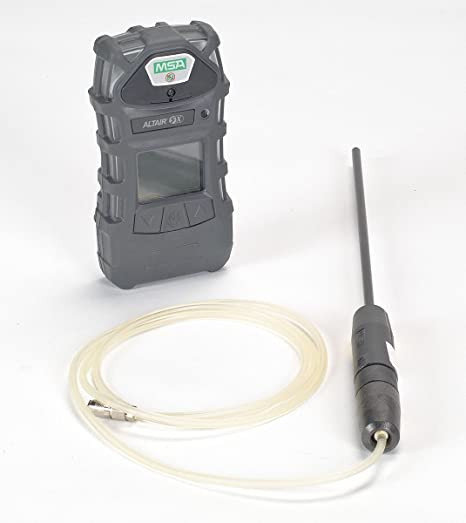
Is the MSA ALTAIR io 6 (10255038) with built-in pump a good multi-gas detector for confined space entry?
Yes. The MSA ALTAIR io 6 (part 10255038) is purpose-built for confined space entry because it has a fully integrated sampling pump inside the instrument — unlike wearable detectors that need snap-on pump accessories — so you can draw and test the atmosphere inside a tank, vessel or manhole before anyone enters. In its standard configuration it detects four gases (combustible/LEL, O₂, CO and H₂S) on a 6-gas capable platform, is approved for Class I, Division 1, Groups A–D (T4) hazardous locations, and adds out-of-box LTE-M cellular connectivity and GPS for real-time visibility of who is entering and where. It's aimed at confined space, turnarounds, plant maintenance and emergency response.
What gases does the MSA ALTAIR io 6 10255038 detect, and what are the measuring ranges?
The MSA ALTAIR io 6 10255038 detects four gases in its standard configuration: combustible gas/LEL (0–100 % LEL or 0–5 % Vol CH₄, catalytic sensor), oxygen O₂ (0–30 % Vol), carbon monoxide CO (0–2000 ppm) and hydrogen sulfide H₂S (0–200 ppm) — the O₂, CO and H₂S sensors are electrochemical. Sensor resolution is 1 % LEL (0.05 Vol % CH₄), 0.1 % Vol O₂, 1 ppm CO and 1 ppm H₂S. It is built on a 6-gas capable platform using MSA XCell sensors, so it can be configured for additional toxic gases.
Can the MSA ALTAIR io 6 10255038 detect additional gases like SO₂, NO₂, ammonia or chlorine?
The MSA ALTAIR io 6 10255038 ships in a standard 4-gas configuration (LEL, CO, H₂S, O₂), but it is built on a 6-gas capable platform, so optional toxic-gas sensors are available: sulfur dioxide (SO₂), nitrogen dioxide (NO₂), ammonia (NH₃) and chlorine (Cl₂). Because the io 6 uses swappable MSA XCell sensors, the gas configuration can be tailored to the hazards of a specific site rather than being fixed at four gases.
Is the MSA ALTAIR io 6 10255038 rated for hazardous locations / intrinsically safe?
Yes. The MSA ALTAIR io 6 10255038 meets or exceeds Class I, Division 1, Groups A, B, C and D, temperature code T4, and also carries ATEX/IEC Ex da ia IIC Ga T4 (with Ex ia I Ma, I M1, II 1G) markings, plus CSA, FCC and Industry Canada approvals. That makes it appropriate for classified hazardous locations where flammable gases or vapors may be present, such as oil and gas, utilities, mining and industrial confined-space work. It operates from -4 °F to 122 °F (-20 °C to 50 °C). Operators must still be trained and follow the MSA user manual before use.
What is the MSA Grid, and how does the ALTAIR io 6 10255038 connect to it?
The MSA Grid is MSA's cloud-based connected-safety platform for fleet management and worksite visibility. The ALTAIR io 6 10255038 connects to it out of the box using built-in LTE-M cellular connectivity — no local Wi-Fi, Bluetooth pairing or network setup required. Gas readings, alarms, device status and GPS location stream automatically and securely to the cloud, where safety teams can view them in real time, push one-click configuration updates over the air, and manage compliance across the whole fleet. The device also keeps a minimum of 90 days of cloud-synced data logs.
What is MSA id on the ALTAIR io 6 10255038, and how does it help fleet management?
MSA id™ is a digital device-assignment system built into the ALTAIR io 6 ecosystem, using an RFID reader and the included MSA ID Tag. It lets safety managers assign a detector to a specific worker and, combined with concurrent GNSS (GPS, GLONASS and Galileo) location accurate to about 8 ft (2.5 m) and secure cloud connectivity, know when, where and who is using each device in real time. Together with the MSA Grid it delivers digital assignments, live location and one-click over-the-air configuration for the whole fleet.
Why does the MSA ALTAIR io 6 10255038 have a built-in pump instead of snap-on sampling accessories?
The ALTAIR io 6 10255038 has a fully integrated pump inside the instrument so it can actively draw air samples for remote or pre-entry testing without adding external pump accessories. Unlike wearable diffusion detectors that rely on snap-on sampling attachments, the io 6's pump is part of the device, simplifying use on the job site, and it remains compatible with existing MSA sampling accessories such as probes and sample lines. This makes it purpose-built for confined-space pre-entry sampling.
How durable is the MSA ALTAIR io 6 10255038, and can the sensors and batteries be swapped?
The MSA ALTAIR io 6 10255038 is built tough: it carries a dust- and waterproof IP65 rating, exceeds 26 drops from 4 ft (MIL-STD-810G 516.6 transit drop), survives an incidental 10 ft (3 m) drop onto concrete, and withstands 60 minutes in the NFPA 1982-2018 tumble tester. It uses swappable sensors and batteries for quick change-outs during lengthy applications, which maximizes uptime, and its high-visibility black-and-white display plus single-hand-operation grips make it easy to read and use on site.
How long does the MSA ALTAIR io 6 10255038 battery last, and how long does it take to charge?
The MSA ALTAIR io 6 10255038 uses a removable, rechargeable Lithium Polymer battery that runs about 16 hours typical (13 hours when a PID sensor is fitted) and charges in roughly 6.5 hours at room temperature (charging range 0–40 °C). It weighs just 0.9 lb (14.4 oz), operates from -4 °F to 122 °F (-20 °C to 50 °C), and its batteries are swappable for uninterrupted use across long or back-to-back shifts.
What comes in the box with the MSA ALTAIR io 6 10255038, and does it ship free?
The MSA ALTAIR io 6 10255038 ships with calibration tubing, a charging cable, spare filters and an MSA ID Tag, and it ships free from Industrial Safety Products. It is a fully connected, 6-gas capable detector configured for LEL, CO, H₂S and O₂ with a built-in sampling pump. Note that gas meters are not eligible for returns or exchanges.
How long do the MSA ALTAIR io 6 10255038 sensors last?
MSA rates the ALTAIR io 6 10255038 sensors for long service life: the combustible/LEL catalytic sensor is rated for 5 years, and the electrochemical O₂, CO and H₂S sensors are each rated for 7 years. Because the sensors are swappable, an individual sensor can be replaced at end of life without retiring the whole instrument, helping maximize uptime and lower long-term cost of ownership.







 Buy in Bulkand Save Big
 Shipping to all Statesto Meet our Customer Needs